Human fingers can transmit data at astonishing velocities. When enthusiasts ask about the fastest typing speed ever recorded, the answer depends on hardware, duration, and text complexity. In short 15-second sprints on modern digital platforms, elite typists have achieved peaks exceeding 300 words per minute (WPM). Historical endurance records on mechanical devices, by contrast, stand near 150 to 216 WPM sustained across lengthy testing sessions. Understanding these records requires analyzing motor mechanics, hardware interfaces, and cognitive processing limits.
High speed pushes human neurology to extreme thresholds. Striking keys at 250 WPM requires inputting more than twenty individual characters every second. That physical tempo leaves fewer than 50 milliseconds per keystroke. At that velocity, conscious visual reaction becomes completely impossible. Your brain must compile words into automated motor sequences dispatched across both hands in parallel. Pushing past physiological limits introduces intense physical strain, requiring strict ergonomic control to prevent tendon injury.
Historical Milestones: The Fastest Typing Speed Ever Recorded on Mechanical Typewriters
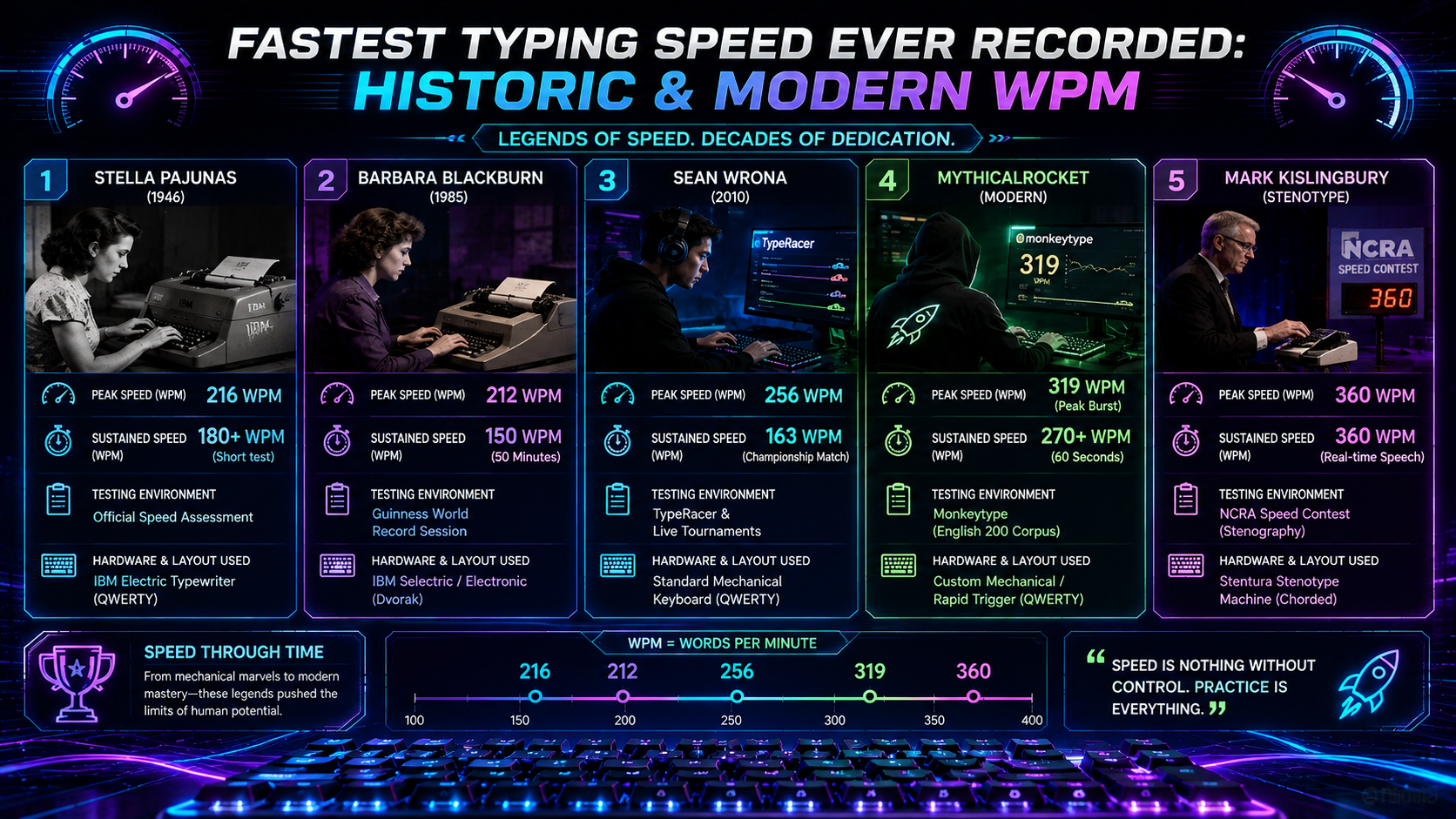
Mechanical keyboards preceded digital sensors by decades. In 1946, Stella Pajunas set an enduring mechanical benchmark by reaching 216 WPM on an IBM electric typewriter during a monitored test. Her performance demonstrated that motor dexterity, rather than electronic switching, defines the primary ceiling of text entry.
💡 Pro Tip: Test your baseline throughput against historical benchmarks using our free TypingPulse Speed Test to analyze your characters per minute and error distribution.
Decades later, Barbara Blackburn redefined sustained typing endurance. Using a Dvorak Simplified Keyboard layout, Blackburn sustained 150 WPM for 50 continuous minutes during an official demonstration. She also achieved a verified peak burst speed of 212 WPM. Her achievement highlighted the ergonomic advantages of the Dvorak layout, which concentrates 70 percent of common keystrokes on the home row.
Mechanical typewriters imposed brutal physical constraints. Striking keys required heavy actuation forces between 60 and 90 grams. Typing too fast on early manual machines caused adjacent metal typebars to collide and jam. Operating at 150 WPM on mechanical hardware demanded immense physical stamina alongside absolute rhythmic discipline.
The Digital Revolution: Who Holds the Fastest Typing Speed Ever Recorded Today?
Modern computing transformed competitive speed typing. Digital keyboards eliminated mechanical typebar collisions, while low-latency browser engines allowed typists to benchmark their throughput instantly. In 2010, Sean Wrona proved digital supremacy by winning the Ultimate Typing Championship, sustaining 163 WPM on complex text and recording a peak speed of 256 WPM on TypeRacer.
| Typist / Champion | Peak Speed (WPM) | Sustained Speed (WPM) | Testing Environment | Hardware & Layout Used |
| Stella Pajunas (1946) | 216 WPM | 180+ WPM (Short test) | Official Speed Assessment | IBM Electric Typewriter (QWERTY) |
| Barbara Blackburn (1985) | 212 WPM | 150 WPM (50 Minutes) | Guinness World Record Session | IBM Selectric / Electronic (Dvorak) |
| Sean Wrona (2010) | 256 WPM | 163 WPM (Championship Match) | TypeRacer & Live Tournaments | Standard Mechanical Keyboard (QWERTY) |
| MythicalRocket (Modern) | 319 WPM (Peak Burst) | 270+ WPM (60 Seconds) | Monkeytype (English 200 Corpus) | Custom Mechanical / Rapid Trigger (QWERTY) |
| Mark Kislingbury (Stenotype) | 360 WPM | 360 WPM (Real-time Speech) | NCRA Speed Contest (Stenography) | Stentura Stenotype Machine (Chorded) |
Recent community leaderboards pushed digital boundaries further. Modern competitive typists like MythicalRocket have logged verified 15-second sprint speeds exceeding 300 WPM on Monkeytype, with peak bursts reaching 319 WPM. However, these sprint scores rely on a simplified 200-word vocabulary without capital letters or punctuation marks.
Sprint records differ from sustained real-world typing. Typing a simple 200-word dictionary measures pure finger sprint mechanics. Typing real literature or technical documentation drops speeds by 20 to 30 percent due to unpredictable punctuation, numbers, and capital shifts. Both benchmarks demonstrate exceptional neuromuscular coordination, but they evaluate distinct cognitive skills.
Biomechanical Pipelining: How 250+ WPM Is Neurologically Possible
How does the human nervous system execute 250 WPM? Biological signal transmission from the retina to the visual cortex takes roughly 150 to 200 milliseconds. If a typist processed letters sequentially, human reaction limits would cap speed at 60 WPM. Elite typists bypass this biological latency through cognitive pipelining.
"Record-breaking typists do not react to individual characters; they parse full sentences in advance and execute pre-compiled motor chords."
Biological pipelining relies on three simultaneous processes:
- Extended Eye-Span Buffering: Elite typists look 5 to 8 words ahead of their physical fingers, feeding a continuous stream of text into short-term working memory.
- Subconscious Motor Chunking: Common letter combinations (n-grams) execute as single ballistic nerve impulses, rolling across adjacent fingers in fluid arcs.
- Parallel Finger Pre-Movement: While the left hand strikes "t", the right hand is already in physical motion toward "h", eliminating sequential delay.
This automated pipeline carries a catastrophic vulnerability: buffer collapse. Encountering an unfamiliar word or unexpected symbol halts the automated motor queue. The typist's gaze snaps back to the point of failure, dropping instantaneous speed by over 40 percent while cognitive re-alignment occurs. Developing buffer stability requires diverse vocabulary training inside our Interactive Typing Practice arena.
Hardware Optimization: The Physical Interface of Speed
World-class speed demands optimized hardware interfaces. When typing at 200+ WPM, input latency between switch contact and USB packet delivery creates physical drag. Elite competitive typists fine-tune their hardware setups to eliminate millisecond delays across the input signal chain.
Modern hardware innovations focus on three core areas:
- Hall Effect Magnetic Switches: Magnetic sensors track continuous stem position, allowing actuation depths as shallow as 0.2 millimeters without mechanical bounce.
- Rapid Trigger Technology: Switches reset instantly the moment upward finger movement begins, eliminating fixed mechanical reset travel.
- 1000 Hz to 8000 Hz USB Polling: High polling rates reduce USB input jitter from 8 milliseconds down to a fraction of a millisecond.
💡 Pro Tip: Verify that your keyboard switch matrix handles rapid simultaneous inputs without key chatter using our free Online Keyboard Tester.
Advanced hardware introduces distinct practical tradeoffs. Setting magnetic switches to ultra-shallow 0.2 mm actuation depths increases accidental misfires caused by resting finger weight. High-end magnetic boards also cost significantly more than standard office keyboards. Hardware removes latency bottlenecks, but finger discipline remains indispensable.
Stenography vs. Standard Typing: Breaking 360+ WPM
Standard keyboards are not the only text entry method. In professional courtroom reporting, stenographers achieve speeds exceeding 300 WPM routinely. In 2004, Mark Kislingbury set the Guinness World Record for stenographic speed by capturing 360 WPM at 97.23 percent accuracy during an official competition.
Stenography achieves extreme velocity through chording. Instead of striking individual letters sequentially, stenographers press multiple keys simultaneously like piano chords. A specialized phonetic dictionary translates chord combinations into full syllables, words, or common legal phrases in a single stroke.
However, stenography involves major operational tradeoffs. Mastering stenographic theory requires two to three years of intensive full-time study. Stenotype keyboards also lack dedicated alphanumeric keys, making them impractical for programming, terminal commands, or spreadsheet navigation. For general computer interaction, standard linear typing remains the universal standard.
Applying World-Record Training Principles to Your Typing
You do not need to break world records to benefit from elite training methodologies. Applying the training principles used by competitive typists will systematically raise your everyday typing velocity. Integrate these structured protocols into your practice routine:
1. Enforce a 98% Accuracy Baseline
Champions prioritize accuracy above raw speed. Making errors shatters your visual lookahead buffer and trains erratic finger spasms. Lower your tempo until you can type entire passages cleanly. Precision establishes the neuromuscular foundation for effortless speed.
2. Isolate Weak Character Transitions
Identify sluggish bigrams and awkward finger reaches on your layout. Targeted drill modules in our Typing Academy Lessons isolate high-friction letter pairings, converting hesitant taps into smooth muscle rolls.
3. Expand Your Lookahead Horizon
Force your eyes to read one full word ahead of your typing hand. Expanding this visual buffer prevents micro-stutters between words. Practice this continuous lookahead technique during daily drills to build fluid, uninterrupted throughput.
Summary: The Frontier of Human Typing Speed
Analyzing the fastest typing speed ever recorded proves that human keyboard throughput is highly trainable. From Stella Pajunas's 216 WPM mechanical record to modern 300+ WPM digital bursts, speed emerges from cognitive pipelining, tactile muscle memory, and low-latency hardware. By applying structured practice and strict accuracy standards, any dedicated typist can unlock substantial velocity gains.
Frequently Asked Questions
Key answers regarding touch typing, benchmarks, and techniques
TypingPulse
Typing & Tech Specialist
Written by typing trainers and keyboard specialists dedicated to helping students and developers achieve touch typing mastery, ergonomic comfort, and competitive WPM speeds.